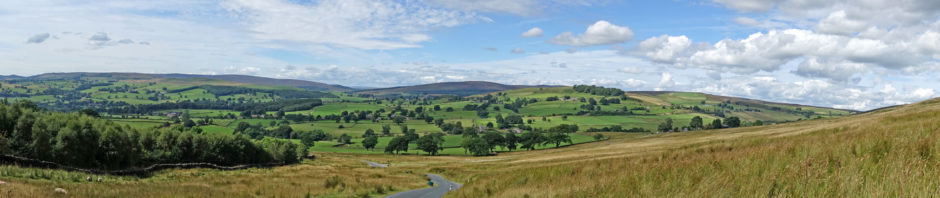
Bolton Abbey in the mist. A beautiful setting

A view through the autumn trees

Related

Bolton Abbey in the mist. A beautiful setting

A view through the autumn trees

Related

Not all the wonderful barns of the Yorkshire Dales have been converted in to holiday lets or cottage homes. These distinctive, rustic almost run-down but utilitarian structures still abound. Originally erected in 18th and 19th centuries many of these barns were built, to store hay near the point of use and were called Laithes, or as Hogg Houses (Hoggs are young sheep) to overwinter the sheep. Tudor Tythe barns still exist at Riddlesden Hall Keighley and Botton Abbey.
The Yorkshire National Park Authority’s Planning Committee have approved the temporary use of a free-standing ‘eco-pod’ inside an isolated barn on the Bolton Abbey estate near Skipton. Yorkshire Forward are supporting this and other conservation measures to protect the 2000 odd barns that are suffering from dereliction.
The National Trust owns Town Head Barn Malham and this 18th century barn has been restored it to its original condition when it would have been used to house overwintering cattle and hay to feed them. It is located on the edge of the village next to its farm and is therefore a rare survival. Most village barns in the Dales have been sold off for house conversions.
Barns of the Yorkshire Dales by Andy Singleton & David Joy is prefaced by Bill Bryson “‘Many of the best of England’s barns are in the Dales. So it is wonderful to see a book celebrating, with wit and affection and penetrating historical insight, the Dales barn in all its undersung glory. This truly is a delightful and valuable book – almost as good, in fact, as the barns themselves.’ ”
Mark Banks Dales Barn series
Main photograph at hardwick House looking towards Nesfield and Beamsley Beacon.
Cowgill and particularly The Sportsmans Inn was a favourite watering hole for our family when the children were young. I was able to drink and the kids could dabble and fall in the Cowgill rivulet.
Nearby is St John the Evangelist church enroute to the railway station for Dent which serves all the villages around. The church has connections to Adam Sedgwick, the father of modern geology, who came from a local family of Vicars. Cambridge University still maintains a museum in his name the Sedgwick Museum of Earth Science but the monument most people will know is the vaguely pyramidal stone on the cobble streets of Dent engraved Adam Sedgwick 1785- 1873.
Returning to the tribulations of the Cowgill Chapel there is an account by Adam Sedgwick of Orthological skulduggery (scanned in by Google) entitled ‘A Memorial by the Trustees of Cowgill Chapel By Adam Sedgwick, Cowgill Chapel (Yorkshire) 1868. The curate of the new church attempted to change the name of the local hamlet from Kirthwaite to Kirkthwaite without informing the trustees of which Adam Sedgwick was one. Since the Sedgwick family were already bemoaning the change of name of Coegill to Cowgill they put up a robust fight resulting in an ecclesiastical court battle. From the foundation stone laying in 1837 until the final protest in 1866 the story hints at empire building and parochial politics that could still be relevant today. With added appendicies about Climate History and Dialects of Dent it makes a fascinating read to see what exercised the bright minds of the time.

Ram in the Yorkshire Dales
This picture is taken from Embsay moor. Straight ahead is the direction of the lower wharfe Valley and Bolton Abbey. To the right is Skipton

Ram in the Yorkshire Dales
This is in the direction of Barden and Burnsall

The river Wharfe in Spring looking from Castley to Pool In Wharfedale
Crossing the Lower Wharfe since the doomsday book times in 1086 has been no mean feat despite fords at Knots Ford and probably Pool where the bridge now stands. Pool bridge was built in 1793 and widened in 1815 and it seems there have been road works there ever since. The volume of water after rain in the dales is massive and has led to flooding many times in near by Castley. Over the years the volume of water must be staggering. This water has been the core of industry at Pool in Wharfedale since the reformation. The original wool mill dated 1673 was swept away with Pool Low Fulling Mill and two bridges. Paper mills (that use lots of water) were built in the 18th century and this trade has been carried on by the Whiteley family and others ever since. A Flour mill was also operated along side the river but the village was located 200 yards away for fear of flooding.
Arthington
A mile to the east of Pool in Wharfedale on the south side of Wharfedale lies Arthington where records of the Priory go back to 1271 and the then prioress, Sara. Other Cluniac nuns in charge included Maud de Kesewik died 1299, Agnes de Pontefract 1302, Isabella de Berghby 1311 (demoted after leaving from the priory without permission), Sibil Plesyngton 1437, Marjorie Craven 1463, Alice Hall 1496 and Elizabeth Hall 1532. The Priory was surrendered in 1540 to Thomas Cranmer. more history
Staircase Lane running from Bramhope through Arthington to Pool is the place of a ghost story based on a wager with a member of the Dyneley family. Whilst galloping his horse down the staircase he was thrown and killed. The ghostly hooves can still be heard today!
Pool
The roads of Old Pool Bank and Pool Bank up to the Dyneley Arms have been the cause of many over-heated car engines and traffic jams as vehicles climbed out of the valley up to Yeadon Airport. These are the main roads between Bradford and Harrogate with other Wharfe crossings at Otley and Harewood. In the village near St Wilfrids church there was a blacksmith and wooden stocks whilst in Arthington there were kilns and forges. There are a couple of pubs, an active village hall and local cricket and football teams.
See more flooding pictures from the Wharfedale Observer

Sheep being taken to the shearing in Nidderdale, near Gouthwaite reservoir
There are more sheep than people in this part of Yorkshire. Sheep farming is a staple of the Yorkshire Dales and plays a role in shaping the countryside of Yorkshire.

Lamb growing up
This lamb is a couple of months old and will soon be ‘ready for the pot’ so to speak

One of our favourite Yorkshire Dales walks is through the lower Wharfe valley between Bolton Abbey and Burnsall. The walk along the river is relatively easy and is surrounded by the dramatic high fells of Burnsall. Along the route there is much interest from the ruins of Bolton Priory to Barden Castle and the beautiful village of Burnsall.

Wharfe Valley between Barden and Burnsall
It is also worth taking a detour away from the river and climb, at least part of the fell to get a breathtaking view along the valley.
There is no shortage of cafes and pubs along the way for refreshments. The cafe at Burnsall offers an excellent array of traditional cafe fayre with home made cakes.

This shot of Yorkshire cows is taken in the Wharfe Valley between Grassington and Burnsall. Generally speaking cows are placid animals who will happily co-exist with humans. However, there are occasions when cows and bulls can present a danger to walkers and ramblers. For anyone who enjoys walking in the countryside it is important to be aware of these potential problems.

Firstly, cows do not look upon humans as a threat. However, they may see dogs as a threat, it harks back to the time when wolfs would attack cows and their calves. Therefore, it is a walker with a dog who is most under threat.
Secondly, the most dangerous time is after new calves are born and the cows feel protective towards their young.
If they see a walker with a dog approaching they may become defensive and attack the person with the dog.
If this was ever to happen, the most important thing is to let go of the dog. Your dog will easily be able to run faster than cows. If the dog runs away from you, the cows will lose interest in you. THe only danger comes when the walker won’t let go of their dogs and so gives the cows a reason to attack. Unfortunately, on very rare occasions tragic incidents of cows trampling over people can occur. However, if you take care to follow basic principles there is no need to fear cows in field

Photo credits Upper Nidderdale looking up-dale Photo by Chris R Oct 2005
Base yourself in Pateley Bridge in Nidderdale for, part or all of, this years festival. Pateley comes from the Old English Paethleah meaning ‘path by a meadow’ and at this festival there are a dozen organised walks, rambles and hikes to suit most abilities.
Like most ‘festivals’ there is plenty of music from Brass and Silver bands, Jazz, Chorale works, Folk and even Gilbert and Sullivan. At least this gives you something to listen too after a walk in verdant Nidderdale or if music isn’t your thing you could ‘take in a talk’. Alternatively ‘Fur Coats and Magic Knickers’ is a comedy play on the 8th July at Pateley Bridge Memorial Hall, let us hope it isn’t fur coat weather but you never know at the top of Middlesmoor even in July.
If you are not one for joining lots of organised events but have an interest in the Arts then there are 19 Exhibitions up and down the dale from How Stean Gorge to Glasshouses and an ‘Art Trail’ leaflet should be available from tourist information.
The Festival is in it’s 13th year let us hope it is lucky for some.

The Beauty of the Yorkshire Dales from Malham Cove.

The craggy limestone pavement at top of Malham Cove. Foreboding clouds in the background heigten the atmosphere, but, the sun manages to come through

photos by Tricky (flickr)
See also images of Wharfedale
Powered by WordPress